Showing posts with label NiB. Show all posts

Tuesday, October 20, 2009

New HIV strain came from gorillas

Medical Tribune September 2009 P3
French scientists have identified a new strain of HIV, which appears to have evolved in gorillas before crossing the species divide.

The virus has a distinct lineage from other HIV strains – notably the one chiefly responsible for the current AIDS pandemic, which is thought to have reached humans from chimpanzees. The researchers, who found the virus in a 62-year-old Cameroonian woman living in Paris, propose calling the new strain HIV-1 group P.

“The discovery of this novel HIV-1 lineage highlights the continuing need to watch closely for the emergence of new HIV variants, particularly in western central Africa, the origin of all existing HIV-1 groups,” they wrote.

[Nat Med 2009 Aug;15(8):871-2]

New fears raised over hormone therapy cancer risk

Medical Tribune September 2009 P3

A new study of almost a million people has strengthened the link between postmenopausal hormone therapy and the risk of developing ovarian cancer.

Danish researchers reviewed registry data from 909,946 women aged 50 to 79, over an average of 8 years of follow up. They found that hormone therapy users had an incidence rate ratio of 1.38 (95 percent CI 1.26 – 1.51) for all ovarian cancers, compared to women who had never used therapy. Cancer risk was increased “regardless of the duration of use, the formulation, estrogen dose, regimen, progestin type and route of administration,” the authors wrote.

“Thus the risk of ovarian cancer is one of several factors to take into account when assessing the risks and benefits of hormone use,” they concluded.

[JAMA 2009 Jul 15;302(3):298-305]

Study flaws hinder review of TCM for stroke

Medical Tribune September 2009 P3
The poor quality of published data prevents a proper assessment of the efficacy of traditional Chinese medicine (TCM) remedies for stroke, a study suggests.

Despite finding 11,234 journal articles on TCM post-stroke therapies, the researchers from Italy and China were unable to conduct a meta-analysis as intended. Thirty four randomized controlled trials (RCTs) were found, but wide variation in the studies prevented them from being pooled. Moreover, all but one RCT reported results in favor of TCM, prompting the authors to suggest a “strong publication bias.”

“The key to lead to evidence-based practices is establishing a consensus on standardized relevant outcome measures and then designing and conducting appropriate RCTs that adopt those standards,” they wrote.

[Stroke 2009 Aug;40(8):2797-804]

Tuesday, September 1, 2009

New risk tool allows prediction of dementia in elderly

Medical Tribune June 2009 P3
David Brill
A new algorithm could help physicians to stratify elderly patients according to their risk of developing dementia.

The late-life dementia risk index was developed using data from 3,375 subjects with a mean age of 76. Just 4 percent of those classified as low risk developed dementia over 6 years, compared to 23 percent of moderate-risk and 56 percent of high-risk subjects.

"This new risk index … could be used to identify people at high risk for dementia for studies on new drugs or prevention methods,” said lead author Dr. Deborah Barnes, University of California, San Francisco, US. “The tool could also identify people who have no signs of dementia but should be monitored closely, allowing them to begin treatment as soon as possible." [Neurology 2009 May 13; Epub ahead of print]

Laughter: The best medicine for cardiovascular disease?

Medical Tribune June 2009 P3
David Brill

Watching comedy shows can improve cardiovascular risk factors, researchers have reported in the journal Psychosomatic Medicine.

The study of 18 healthy people found that arterial stiffness and central hemodynamics improved after watching a 30-minute section from the movie Naked Gun. Cortisol and von Willebrand factor levels also decreased with laughter, reported the team from Athens Medical School, Greece.

Watching stressful scenes, however, had the opposite effect: carotid-femoral pulse wave velocity increased after watching a 30-minute clip from Saving Private Ryan. Stressful viewing also lowered interleukin-6 levels, but did not affect fibrinogen or soluble CD40 ligand levels. [Psychosom Med 2009 Feb 27]

Gene variants point to East Asian health risks

Medical Tribune June 2009 P3
David Brill

Korean scientists have identified East Asian-specific gene variants which play a role in obesity, blood pressure, bone density and pulse rate.

The group, led by the National Institute of Health, Seoul, conducted the first large-scale genome-wide association study of an East Asian population. They analyzed 8,842 samples from Korean population-based cohorts.

Besides identifying novel East Asian gene variants, they also found that many genetic markers are shared with Europeans, including several which play a role in height, body mass index, type 2 diabetes, obesity, heart disease and osteoporosis. [Nat Genet 2009 May;41(5):527-34]

Tuesday, February 10, 2009

Quality of life in heart failure not affected by defibrillators

Medical Tribune October 2008 P3

Implantable cardioverter-defibrillators (ICDs) do not decrease quality of life for patients with stable heart failure, a study from Duke University Medical Center, US, has concluded.

The randomized trial involved 2,521 patients – all receiving optimal medical therapy along with either a single-lead ICD, amiodarone or a placebo. Physical functioning did not vary significantly between the groups at baseline, 3, 12 or 30 months, while psychological well-being was significantly improved in the ICD group at 3 and 12 months but not at 30.

Receiving a shock in the month preceding assessment, however, was associated with a reduced quality of life. [N Engl J Med 2008 359(10):999-1008]

Chewing gum speeds recovery from bowel cancer op

Medical Tribune October 2008 P3

Chewing gum could help patients to recover after colectomy, a recent meta-analysis has shown.

The study, including five randomized controlled trials totaling 158 patients, found that gum significantly reduced the time to first flatus and first bowel movement following the operation. Postoperative hospital stay was also reduced, but this result did not reach statistical significance.

The researchers, from Imperial College London, UK, suggest that gum could serve as a form of “sham feeding” which stimulates the production of saliva, gastrointestinal hormones and pancreatic secretions.The potential for substantial cost savings means that larger placebocontrolled trials into the effects of chewing gum are warranted, they conclude. [Arch Surg 2008 143(8):788-93]

Antipsychotic drugs raise risk of stroke

Medical Tribune October 2008 P3

Stroke risk is raised by all antipsychotic drugs and not just atypical types as previously thought, according to UK researchers.

Electronic primary care records were used to identify 6,790 patients with a history of stroke and taking antipsychotic medications. Compared to non-medicated periods, the rate ratio for stroke when taking any antipsychotic drug was 1.73 (95% CI 1.60 – 1.87). For typical antipsychotics alone the ratio was 1.69 (95% CI 1.55 – 1.84), whereas for atypical drugs alone this figure was 2.32 (1.73 – 3.10).

Patients with dementia who took any antipsychotic were at markedly increased risk for stroke (rate ratio 3.50; 95% CI 2.97 – 4.12), and the authors advise that these drugs be avoided where possible in these patients. [BMJ 2008 337:a1227]

Friday, February 6, 2009

Laquinimod shows promise for multiple sclerosis

Medical Tribune August 2008 P3

The novel immunomodulatory agent laquinimod appears to reduce disease activity in relapsing-remitting multiple sclerosis and could be a promising new treatment for the condition.

A randomized phase IIb trial involving 306 patients found that, compared to patients who took placebo, those who took oral laquinimod (.6 mg daily) had a 40.4 percent reduction in the number of gadolinium enhancing lesions seen on magnetic resonance imaging at weeks 24, 28, 32 and 36. The drug was well tolerated, with a similar adverse event rate to placebo.

The drug is due to undergo further assessment in a phase III clinical trial.
[Lancet 2008 Jun 21;371(9630):2085-92]

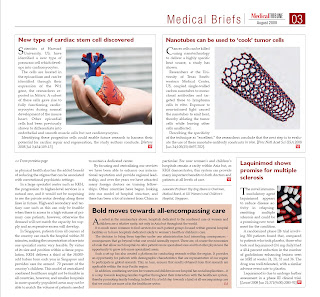
Nanotubes can be used to ‘cook’ tumor cells

Medical Tribune August 2008 P3

Cancer cells can be killed using nanotechnology to deliver a highly specific heat source, a study has shown.

Researchers at the University of Texas Southwestern Medical Center, US, coupled single-walled carbon nanotubes to monoclonal antibodies and targeted these to lymphoma cells in vitro. Exposure to near-infrared light caused the nanotubes to emit heat, thereby ablating the tumor cells while leaving other cells unaffected.

Describing the specificity of the technique as “excellent”, the researchers conclude that the next step is to evaluate the use of these nanotube-antibody constructs in vitro.

[Proc Natl Acad Sci U S A 2008 Jun 24;105(25):8697-702]

New type of cardiac stem cell discovered

Medical Tribune August 2008 P3

Scientists at Harvard have identified a new type of precursor cell which develop into cardiomyocytes.

The cells are located in the epicardium and can be identified through their expression of the Wt1 gene, the researchers reported in Nature. A subset of these cells gave rise to fully functioning cardiomyocytes during normal development of the mouse heart. Other epicardial cells had been previously shown to differentiate into endothelial and smooth muscle cells but not cardiomyocytes.

Identifying these progenitor cells could enable future research to harness their potential for cardiac repair and regeneration, the study authors conclude.

[Nature 2008 Jun 22. Epub ahead of print]

Thursday, February 5, 2009

Oral estrogen linked to venous thromboembolism

Medical Tribune July 2008 P3

Taking oral estrogen more than doubles the risk of venous thromboembolism (VT), according to a meta-analysis comprised of nine randomized controlled trials and eight observational studies.

The odds ratio for developing a clot among
current users of oral therapy was 2.5 compared
to non-users. This risk was highest in the first year of treatment, during which the odds ratio for developing VT was four. Conversely there was no significant elevated risk associated with estrogen given by transdermal patch.

The authors concluded that using this method of delivery could improve the safety and benefits of hormone replacement therapy. [BMJ 2008 May 31;336(7655):1227-31]